Native ad headlines: the patterns that win the click — and why they work
On native, the headline isn't part of the ad — it basically is the ad. A thumbnail, a dozen words, and a feed full of real news to compete with. Here are the patterns that keep winning, and the hundred-year-old reasons why.

On most ad platforms, the headline is one ingredient among many. On native, it’s nearly the whole recipe.
A native ad — the sponsored stories in the “recommended for you” widgets on news sites, served by networks like Taboola, Outbrain, and MGID — is a thumbnail and a dozen words. No video to carry it, no brand equity to lean on, no search intent to ride. Your twelve words sit in a feed next to actual news headlines, written by actual editors, and they have to win that fight for a stranger’s next click.
That’s why headline testing is where native campaigns are won — and why, as I wrote in the direct-response piece, the biggest CPA improvement I’ve ever gotten from a single change was a headline. Not the bid, not the audience, not the landing page. The words.
This article is the patterns behind that: what winning native headlines look like, why they work, and where the line runs between curiosity and clickbait.
Why native headlines are their own craft
Three things make native different from every other headline you’ll write:
The reader wasn’t looking for you. Search headlines answer a query — intent already exists. A native reader was reading the news; your headline has to create the itch it will scratch. That’s a colder start, and it changes what works.
You’re competing with editorial, not ads. In the widget, your headline sits beside “What the new tax rules mean for homeowners.” Headlines that sound like ads — brand names, exclamation marks, BUY NOW energy — lose to headlines that sound like stories. The winning register is editorial with a pulse.
The headline’s job is the click, not the sale. The prelander does the selling. The headline has exactly two jobs: stop the right reader, and make a promise the next page can keep. Every word beyond those two jobs is waste.
The four levers — and the ten classic types built on them
John Caples spent decades testing headlines and found that the great ones lean on at least one of four qualities: self-interest, news, curiosity, or a quick-easy way. A century later, every native headline that’s ever worked for me maps onto that same short list. The ten types below are the classics of the trade — most of them older than television — translated into native clothes. Learn to recognize the lever under each one, and you can write fresh headlines forever.
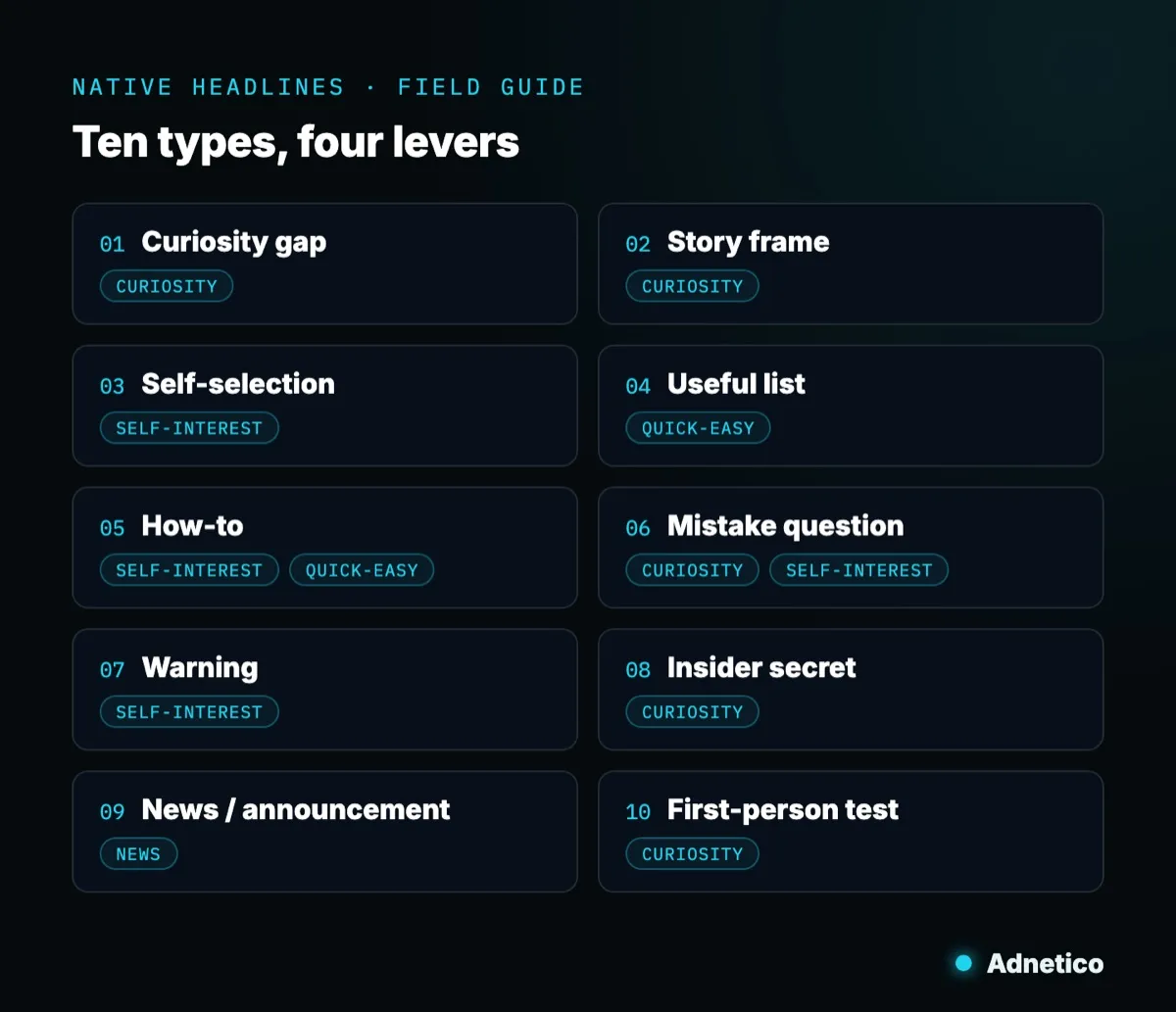
1. The curiosity gap — specific, but incomplete
“The mistake most people make in the first hour after waking up”
“Doctors were asked to stop recommending this common supplement”
The native workhorse. It names something concrete enough to feel real, and withholds exactly one thing — the thing the click delivers. The specificity is what separates it from spam: “this weird trick” is dead; “the first hour after waking up” still works, because the reader can locate themselves inside it.
Why it works: an opened loop demands closing — the same mechanism that keeps quiz-takers finishing quizzes. The risk: the prelander must actually close the loop, or the visit ends in a bounce and the trust ends with it.
2. The story frame — a person, a situation, a turn
“A 54-year-old teacher tried the ‘memory workout’ neuroscientists talk about”
“He spent 20 years buying ads. Then he noticed what the platforms don’t show you.”
Editorial camouflage in the best sense: it reads like the feature stories around it. The grandfather of this type is Caples’ own 1926 classic — “They laughed when I sat down at the piano. But when I started to play!” — a character, a situation mid-turn, an implied outcome.
Why it works: stories are the one format humans can’t not process — and identification does the audience selection for you. A 54-year-old teacher headline selects readers who are roughly that person.
3. Self-selection — the headline as a filter
“Renters in Bilbao are switching to this home-insurance model”
“If your ad spend passed €10K a month, read this before scaling”
The headline names its reader — by geo, age, situation, or spend level — and everyone else scrolls past. On native this is often the point: you pay per click, so a headline that repels the wrong clicks is saving you money, not costing you reach. Geo macros ({city}-style dynamic insertion) are the industrial version, and the platforms support them for a reason.
Why it works: Schwartz again — you’re not creating desire, you’re finding the readers who already have it. The caveat: platform rules on personalization and sensitive categories are real; calling out health conditions or financial distress by name is exactly what gets ads rejected.
4. The useful list — news you can use
“7 things mechanics check before buying a used car”
“The 3 questions to ask before you pay for any online course”
The least glamorous pattern and the steadiest. Numbers promise structure, structure promises easy consumption — Caples’ “quick, easy way” lever, intact since the 1920s.
Why it works: it makes the smallest promise of the bunch, so it attracts the most pre-sold, least disappointed visitor — often the best converting clicks even when the CTR is midfield.
5. The how-to — the oldest workhorse
“How to check what your car is actually worth (before the dealer does)”
“How a small brand gets on national TV without an agency”
How to Win Friends and Influence People is a how-to headline that sold thirty million books. The formula survives because it’s a pure self-interest promise: a skill or outcome, delivered.
Why it works: it promises competence — the reader leaves better at something. On native, the parenthetical twist (“before the dealer does”) adds the curiosity spark the flat how-to lacks.
6. The mistake question
“Do you make these 6 mistakes when booking flights?”
“Are you overpaying for electricity without knowing it?”
The vintage anchor here is Maxwell Sackheim’s “Do You Make These Mistakes in English?” — which ran, essentially unchanged, for about forty years. The word “these” is the engine: it implies a specific list the reader can’t see yet.
Why it works: self-interest plus curiosity plus a pinch of anxiety — nobody is sure they don’t make the mistakes. The risk: rhetorical questions with obvious answers (“Want to save money?”) are dead weight; the question must genuinely be undecidable from the outside.
7. The warning
“Don’t book a hotel in {city} before reading this”
“Warning: the ‘free trial’ clause most people never read”
Negative framing, protective promise. It positions the click as loss-avoidance rather than gain — and loss-avoidance is the stronger motivator for most audiences.
Why it works: fear of a mistake already made (or about to be) outpulls hope of improvement in many verticals — insurance, finance, home services especially. The caveat: platforms read alarmism closely; the warning has to be substantiated on the prelander or it’s a rejection waiting to happen.
8. The insider secret
“The booking trick flight attendants use for their own holidays”
“What car dealers hope you never find out about year-end pricing”
Curiosity with an authority chaser: someone on the inside knows something, and the click transfers the knowledge. The “enemy” version — what X doesn’t want you to know — adds an us-versus-them charge.
Why it works: it flatters the reader into the in-group and dangles asymmetric information. The risk: the oldest pattern for overclaiming; if the “secret” turns out to be common knowledge, the bounce is instant and the complaint rate isn’t zero.
9. The news / announcement
“New rules change what {city} homeowners pay for solar in 2026”
“Finally: a legal way to watch regional sports without cable”
The most native-native pattern of all — it is a news headline, with a commercial answer behind it. “New,” “finally,” “now,” a date, a rule change: the news lever, straight up.
Why it works: it borrows the exact register of the feed it sits in, and recency is its own reason to click today rather than someday. The caveat: the news must be real. Fake regulatory changes are a fast track to banned creatives.
10. The first-person test
“I tracked every euro my ads spent for 90 days — here’s what I found”
“I tried the 4-minute morning routine for a month. It wasn’t what I expected.”
The modern native staple: a personal experiment with an unstated result. It’s the story frame in first person, with the credibility of lived experience and a built-in curiosity gap (“wasn’t what I expected”).
Why it works: first person reads as testimony, not advertising — Halbert’s one-human-to-another voice compressed into a headline. It also sets up a story advertorial perfectly: the prelander simply is the promised account.
Ten types, four levers — and one scoreboard that decides which of them earns your budget…
CTR is not the scoreboard
Here’s the native-specific trap: the headline that wins on CTR is often not the headline that wins on CPA.
A shock headline can double your click-through while filling the prelander with curiosity tourists who bounce in seconds. You pay for every one of them. A quieter, more selective headline can post a modest CTR and quietly halve your cost per acquisition, because everyone who clicked was the right reader with the right expectation.
So the rule I test by: judge headlines by CPA and what happens after the click — completion, lead quality, soft conversions — never by CTR alone. CTR decides what a click costs; congruence decides what a click becomes. The headline controls both, and only one of them shows up in the widget.
That’s also the honest definition of clickbait: not “a curious headline” — curiosity is the craft — but a promise the next page doesn’t pay. The platforms police it (native networks reject overclaims and bait-and-switch routinely, and the FTC’s truth-in-advertising rules apply to the whole chain), but the economics police it harder. Unpaid promises convert once and refund twice.
How I test headlines on native
The practical loop, from years of running this on gaming, e-commerce, supplements, and lead gen:
- Write more than feels reasonable. A new campaign starts with a wide spread of headlines across the four patterns above — not three variations of one idea, but genuinely different levers.
- Pair them with congruent prelanders. A story headline feeding a story advertorial; a question headline feeding a quiz. Congruence is a multiplier.
- Kill on CPA, not CTR. Let the platform rotate, cut the losers on cost per acquisition and post-click quality, then write the next round around the winner’s lever.
- Respect the fatigue curve. Native headlines wear out — the audience pool sees them, CTR sags, CPCs creep. The pattern that won keeps winning longer than the exact words do. Rotate the words, keep the lever.
Two real ones from my own campaigns, to make it concrete. For a gaming offer in the US, the headline that refused to lose was “Don’t Play This Game If You’re Under 40” — a warning, an age filter, and a dare welded into one line. CTR ran close to 1%, and CPA came in around $8–9 while every other headline we tested sat at $13–14. For e-commerce, “Why Everyone Is Ordering This New $99 Drone” pulled far ahead of everything else we ran — bandwagon plus a specific price. (I no longer have the exact numbers on that one, and I won’t invent them.)
Notice that neither winner is a single “pure” type. That’s the pattern behind the patterns: the headlines that keep winning are usually two levers welded together — a warning that’s also a filter, social proof that’s also a price anchor. Learn the ten types to recognize the parts; combine them to build the winners.
Native headline FAQ
How many headlines should I test on a native campaign?
More than you think — a fresh campaign should launch with a wide spread across genuinely different types (curiosity gap, story, warning, how-to, news, first-person test…), not minor rewordings of one idea. The platforms’ auto-rotation only helps if the variants are actually different. Cut on CPA and post-click quality, then iterate around the winning angle.
What’s a good CTR for native ads?
It varies too much by geo, vertical, placement, and bid strategy for a universal number to mean anything — and chasing CTR alone is the classic native mistake. Benchmark your own account: what matters is the relationship between CTR and CPA per headline. A mid-CTR headline with the best CPA is your winner.
Do question headlines work on native?
Yes, when the question self-selects the right reader (“Is your ad spend past €10K a month?”) rather than begging a rhetorical yes (“Want to save money?”). A good question headline is a filter; a lazy one is noise. Test them against story and curiosity frames — the winner differs by vertical.
What’s the difference between curiosity and clickbait?
Whether the next page pays the promise. Curiosity names something specific and delivers it after the click; clickbait borrows attention it can’t repay. The first is the oldest tool in direct response; the second gets ads rejected, accounts flagged, and budgets burned on visitors who bounce.
Where to go from here
If your native campaign’s headlines haven’t been seriously tested — or they’re winning CTR and losing CPA — that’s the highest-leverage fix available to you, and it costs words, not budget.
Take the free audit and I’ll tell you whether your leak is the headline, the page, or the offer. And if the fix is the page under the headline, that’s what we build.