What is a VSL? Why video sales letters convert cold traffic — and the people who proved it
The highest-converting video format in direct response was born ugly on purpose: black text on a white screen, read out loud. Here's what a VSL actually is, why it works, and what Benson, Brunson, and Hormozi each added to it.

Around 2007, a fitness author ran an accidental experiment that changed direct response.
He had a professionally produced sales video — polished, designed, expensive. Against it he tested something he later called “ugly” on purpose: plain black text on a white screen, a few words in red, no faces, no footage, just his voice reading the words as they appeared.
The ugly version reportedly outsold the polished one by around 600%.
That author was Jon Benson, and the format he stumbled into — a sales letter you watch — became the VSL, the video sales letter. Within a few years it was the default selling machine of ClickBank — the affiliate marketplace where digital info products are bought and sold — the engine behind nine-figure supplement brands, and the format half the internet’s health and finance offers still run on today.
If you’re buying cold traffic and you’ve never seriously considered a VSL, this is the article I’d want you to read first: what it is, why it works, who shaped it, and when it beats the alternatives.
What a VSL actually is
A VSL is a sales letter delivered as a video. Not a brand film, not a product demo, not an explainer with stock footage and royalty-free music — a structured, persuasive argument, written like direct-response copy and performed as narration, that walks a cold viewer from a hook to a single call to action.
The classic page is almost comically simple: a headline, the video, and a buy button — which often doesn’t even appear until the video reaches the pitch. That’s it. The video is the page.
In paid-traffic terms, the VSL is a prelander — the warming step between the ad and the offer — that happens to use sound and motion instead of text. It competes for the same slot as the advertorial: both exist because cold traffic isn’t ready to buy, and something has to do the selling before the checkout asks for the decision.
Why an ugly video outsold a beautiful one
The Benson story isn’t trivia — it contains the whole theory of the format.
The polished video looked like advertising, so people’s guard went up and their attention drifted. The ugly one looked like information. Text appearing on screen, read aloud, does three things a produced video doesn’t:
It controls pacing. A reader of a sales page can skim, jump ahead, and find the price before you’ve made the case. A viewer can’t. The VSL delivers the argument in the exact order the copywriter wrote it — problem before mechanism, mechanism before proof, proof before price. In copy terms, nobody reads your close before your hook.
It doubles the channel. Hearing the words while reading them is more engaging than either alone. There’s a reason the format kept the on-screen text even after budgets got big.
It removes the “ad” costume. No jump cuts, no actors, no gloss — nothing that triggers the learned reflex of this is a commercial, ignore it. What’s left is a voice telling you something that sounds like it matters.
None of that is a loophole. It’s the oldest lesson in direct response wearing a new medium: the words do the selling. Production value is optional; the argument isn’t.
The classic VSL structure
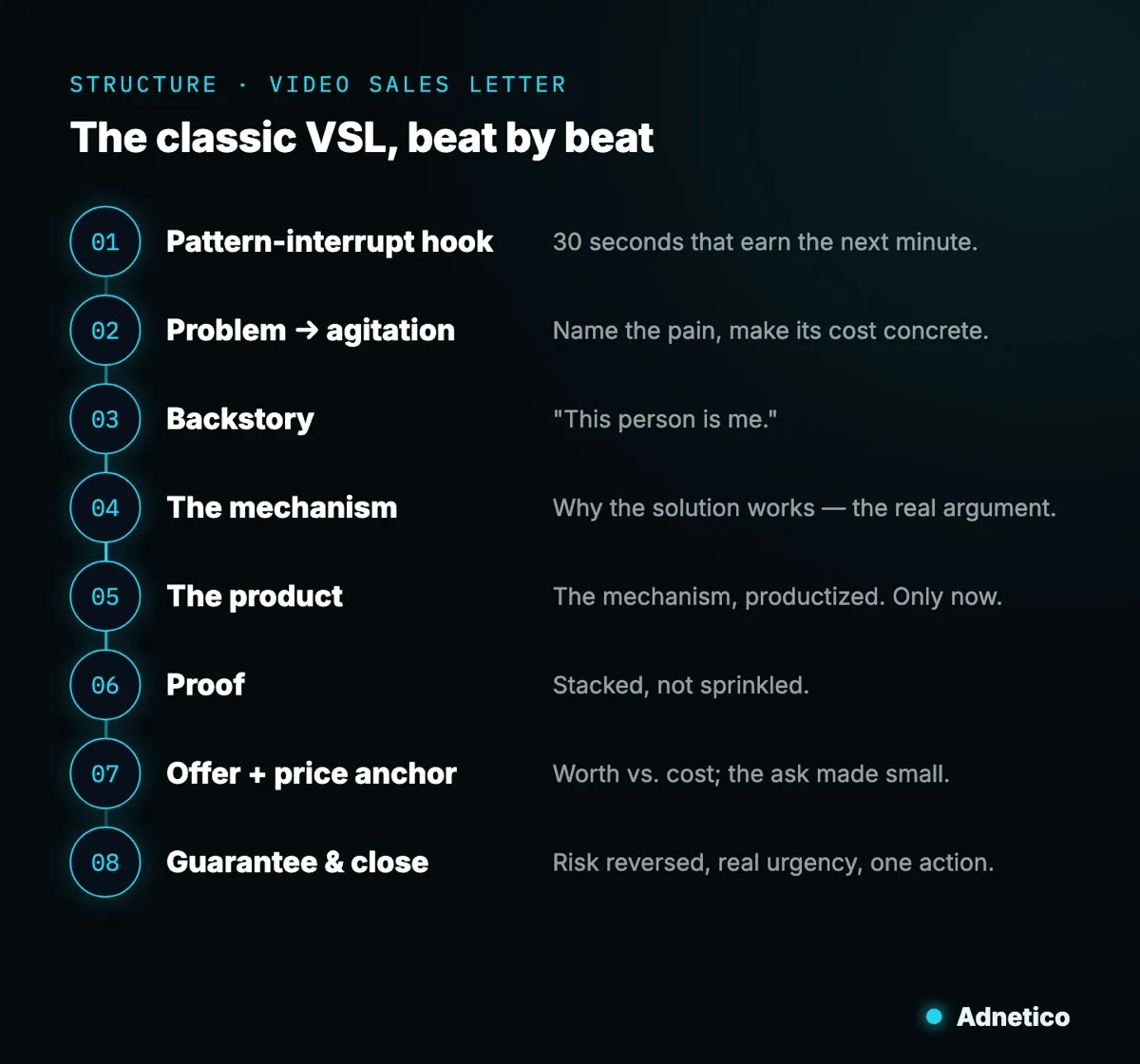
The skeleton that ClickBank ran on — and that most VSLs still follow — is a sales letter’s skeleton, timed for audio:
- Pattern-interrupt hook. The first 15–30 seconds earn the next minute: a shocking claim, a counterintuitive fact, a question the viewer can’t ignore.
- Problem, then agitation. Name the pain in the viewer’s words, then make its cost concrete. Weight, not drama — the same rule as any good copy.
- The backstory. The narrator was where the viewer is now. This is the identification beat: this person is me.
- The discovery — the mechanism. The turn of the story: why the solution works. The “unique mechanism” is what separates a VSL from an infomercial pitch — it gives the viewer a new explanation for their old problem.
- The product. Only now. The mechanism, productized.
- Proof. Results, testimonials, credentials, demonstrations — stacked, not sprinkled.
- The offer and the price anchor. What it’s worth versus what it costs, bonuses stacked, the ask made small against the value built.
- Guarantee, urgency, close. Risk reversed, a real reason to act now, and one action — repeated.
If that list looks familiar, it should: it’s the anatomy of a cold-traffic advertorial with a timeline instead of a scroll bar. Same species, different habitat.
The people who shaped the format
Direct response has a long bench, but three names matter most if you want to understand where VSLs came from and where they went.
Jon Benson — the inventor. A fitness author who became, by his own telling, the first to run two top-10 books on ClickBank at once. His contribution wasn’t just the ugly format; it was proving that removing production value could raise conversions — that a VSL is copywriting first and video a distant second. He spent the following decades systematizing VSL scripts (and later selling software that writes them), but the insight from around 2007 is the durable part.
Russell Brunson — the systematizer. The ClickFunnels founder turned the intuitions of the format into teachable frameworks. Hook, Story, Offer — his diagnosis for any funnel: if it’s not converting, one of the three is broken. The Epiphany Bridge — a script for telling the story of the moment you discovered the mechanism, so the viewer arrives at the conclusion themselves instead of being pushed. And the Perfect Webinar — effectively a 90-minute VSL that spends most of its runtime dismantling the viewer’s false beliefs before it dares to pitch. You don’t have to like the guru aesthetic to respect the engineering: Brunson mapped belief change, which is what every long-form sales video is actually doing.
Alex Hormozi — the modern era. Hormozi’s Value Equation — value = (dream outcome × perceived likelihood) ÷ (time delay × effort) — isn’t a VSL formula, it’s an offer formula, and that’s the point: his generation moved the leverage from the video’s theatrics to the offer’s math. His own long-form videos barely look like VSLs at all — direct-to-camera, teaching openly, proof-heavy, almost anti-hype — and that is the current style: the pitch dressed as a lesson, credibility built by giving away the how.
Behind all three stands the older lineage — Kennedy-style sales letters, the Agora-school financial promotions that ran hour-long doom-and-opportunity VSLs to cold lists for decades. The format’s family tree is just direct mail with a play button.
VSL, advertorial, or quiz — which one for your funnel?
All three are prelanders. All three warm cold traffic. The choice is about what your offer needs and what your traffic tolerates:
- The VSL wins when the story needs performance — emotion in a voice, a demonstration on camera, a founder whose delivery is the proof. High-ticket offers, transformation products (health, fitness, wealth), and anything where belief change takes twenty minutes of argument tend to convert best with a VSL.
- The advertorial wins when the platform or audience favors reading — native networks are editorial environments, and an article-shaped page matches how the visitor arrived. It’s also faster and cheaper to test: rewriting a page beats reshooting a video.
- The quiz wins when the audience is segmented and the offer changes with the answers — diagnosis products, lead gen, multi-buyer offers.
They stack, too. Quiz → VSL is a classic pairing: the quiz segments, the VSL sells to the segment. And on native specifically, a text advertorial with an embedded VSL is often the compliance-friendly compromise — the article warms, the video closes.
You don’t send the click straight to the VSL
Here’s the detail most explainer articles skip: on Meta and native, the click from the ad usually doesn’t land on the VSL at all. There’s a one-page prelander in front of it — a strong headline and subheadline, a thumbnail that looks like a video with a play button in the middle, a few testimonials or trust factors, short copy. Its only job is to sell the click into the video. A visitor who chooses to press play is a different viewer than one a video was forced on: they’ve already committed. From campaigns I’ve seen and run, a good gateway page like that reaches a 40–60% LP CTR on Meta traffic — the share of visitors clicking through to the video — with native typically coming in lower.
One more practical warning: autoplay with sound is restricted or penalized on most placements, and a video that requires sound in a feed full of muted phones is a leak. Captions aren’t optional anymore; the modern VSL assumes silence until the viewer opts in.
Full disclosure, since this blog trades on first-hand numbers: VSLs are the format I’ve run least. Most of my own native spend goes to advertorials and quizzes — reading formats fit editorial placements, and they’re faster to test. But the funnel logic above is the same logic I run every day; the prelander math doesn’t care whether the warming step is a page or a video.
Where bad VSLs go wrong
The format earned its scammy reputation honestly — through abuse. The failure modes:
- Hype instead of mechanism. Twenty minutes of income claims and lifestyle b-roll with no explanation of why the thing works. The mechanism is the argument; without it there’s nothing to believe.
- The unskippable hostage video. No scrub bar, no pause, fake “the video is about to end” warnings. Captive pacing is the format’s power; weaponizing it burns trust.
- Fake countdown, fake scarcity. A timer that resets on refresh teaches the viewer exactly one thing: this seller lies.
- Claims that can’t survive daylight. Health and finance VSLs live under real advertising rules — the FTC’s, and every ad platform’s. “Results not typical” isn’t a magic footnote; unprovable claims kill accounts and, eventually, businesses.
- Burying the offer. If the pitch starts at minute 38, most of your buyers left at minute 12. Long is fine — the classic VSLs are long — but every minute has to earn the next.
- Polish replacing substance. The inverse Benson error: beautiful footage, drone shots, cinematic grade, no argument. You can spend $50K producing the thing his ugly slides beat.
The VSL FAQ
How long should a VSL be?
As long as the argument needs and not a minute more — which in practice means 5–15 minutes for most e-commerce and lead-gen offers, and 20–45 for high-ticket or belief-heavy transformations. Length follows the size of the ask: the more the viewer has to believe (and spend), the more argument you’ve earned. Test shorter cuts against the full letter; the winner is rarely the one you’d guess.
Do “ugly” text-on-screen VSLs still work?
Yes — the mechanism that made them work (paced argument, dual channel, no ad costume) didn’t expire. But the bar moved: pure text-on-white now reads as dated in most verticals, so the common modern form is a hybrid — narrated text beats mixed with b-roll, screen recordings, or a direct-to-camera presenter. The copy still carries it.
What’s the difference between a VSL and a sales page?
Content, nothing; control, everything. A VSL is a sales letter the viewer consumes in the writer’s order at the writer’s pace, while a sales page is the same letter the reader can skim, reorder, and abandon at the price. That control is why VSLs tend to win on cold traffic and lose on warm traffic — a returning visitor who already wants the thing doesn’t want to sit through your argument again.
Do I need a studio to make one?
No. You need a script — that’s the actual product — plus a voiceover, on-screen text, and basic editing. A converting VSL has been made with a slide deck and a USB microphone thousands of times. Spend on the script and the offer first, the camera last.
Where to go from here
If you’re running cold traffic and deciding what should sit between your ad and your offer — a VSL, an advertorial, a quiz, or some stack of them — that’s exactly the kind of call I make for clients every week.
Take the free audit and I’ll tell you where your funnel is leaking and which warming format fits your offer, your platform, and your budget. If the answer is a written one, that’s what we build.