Why your native campaign bleeds after the click
Cold native traffic doesn't arrive ready to buy, and most product pages assume it does. That gap — between the click and the sale — is where the money leaks, and where an advertorial earns its keep.

Most native campaigns don’t fail at the click. They fail after it.
The ad works. People click. Your CTR looks fine, the spend goes out, the dashboard fills with traffic. Then you check conversions and the number doesn’t move. So you blame the audience, the platform, the creative. You raise the bid and lose money faster.
The usual culprit is the one most teams suspect last: the page the click lands on. Cold native traffic doesn’t arrive ready to buy, and most product pages assume it does. The gap between those two facts is where the money leaks.
Why product pages fail cold traffic
A product page is built for someone who already decided. Look at what it asks you to do: compare the price, scan the features, weigh the guarantee, pick a plan. That’s a page for a reader who already believes three things:
- I have this problem.
- I want this kind of solution.
- I trust this offer enough to judge it on price, features, and terms.
Warm traffic believes all three. Someone who searched your brand, opened your email, or abandoned a cart has already done the believing — the product page just closes what’s open.
Cold native traffic believes none of it. They were reading a news article, your headline caught them mid-scroll, they clicked out of curiosity. They don’t know they have the problem, don’t know your category is the fix, and have never heard of you. Drop them on a product page and you’ve handed a buying decision to someone who hasn’t had the conversation that leads to one.
That’s how you get a healthy CTR and a dead conversion rate at the same time. The ad did its job — it earned the click. The page asked for a decision the reader wasn’t ready to make.

What an advertorial actually is
An advertorial is the page that has that conversation first.
The word is a blend of advertisement and editorial: a page that reads like a story or an article and is built to sell. It earns attention the way editorial does — a hook, a story, a useful idea — and uses that attention to walk a cold reader from “who are you” to “I want this,” then hands them to the offer warmed up.
In paid-traffic terms it’s the prelander or bridge page — the step between the ad and the product page. The ad sells the click. The advertorial sells the reader. The product page takes the order.
What an advertorial is not
- Not a blog post. A blog post informs and stops. An advertorial informs and then asks for the sale.
- Not your product or landing page. Those assume the reader already wants the thing. The advertorial builds the want first.
- Not a banner with more words. It’s a structured argument with one job: move one reader, one step at a time, toward one action.
- Not fake news. A good advertorial reads like editorial because that’s the format people choose to read — not to disguise that it’s an ad. That line matters, and I’ll come back to it.
You probably need one if…
You can diagnose this in a minute. You probably need an advertorial if:
- Your native CTR is decent but conversions are weak — the ad works, the page doesn’t.
- People click and bounce on the product page without scrolling or adding to cart.
- Your offer needs explaining — it isn’t obvious in five seconds why it’s worth the money.
- Your product solves a problem people weren’t actively searching for — there’s no existing intent to ride.
- Cold traffic doesn’t yet understand why the product matters to them specifically.
- Your landing page assumes the reader already wants the solution — it starts at the close instead of the setup.
If two or three of those are true, the leak is almost certainly the page, not the traffic.
If you’re running cold native traffic and you’re not sure whether the page is the problem, we can take a look at the funnel and point out where the leak is — the page, the offer, or the angle. Take the free audit and you’ll get a read on what to fix first.
The anatomy of a cold-traffic advertorial
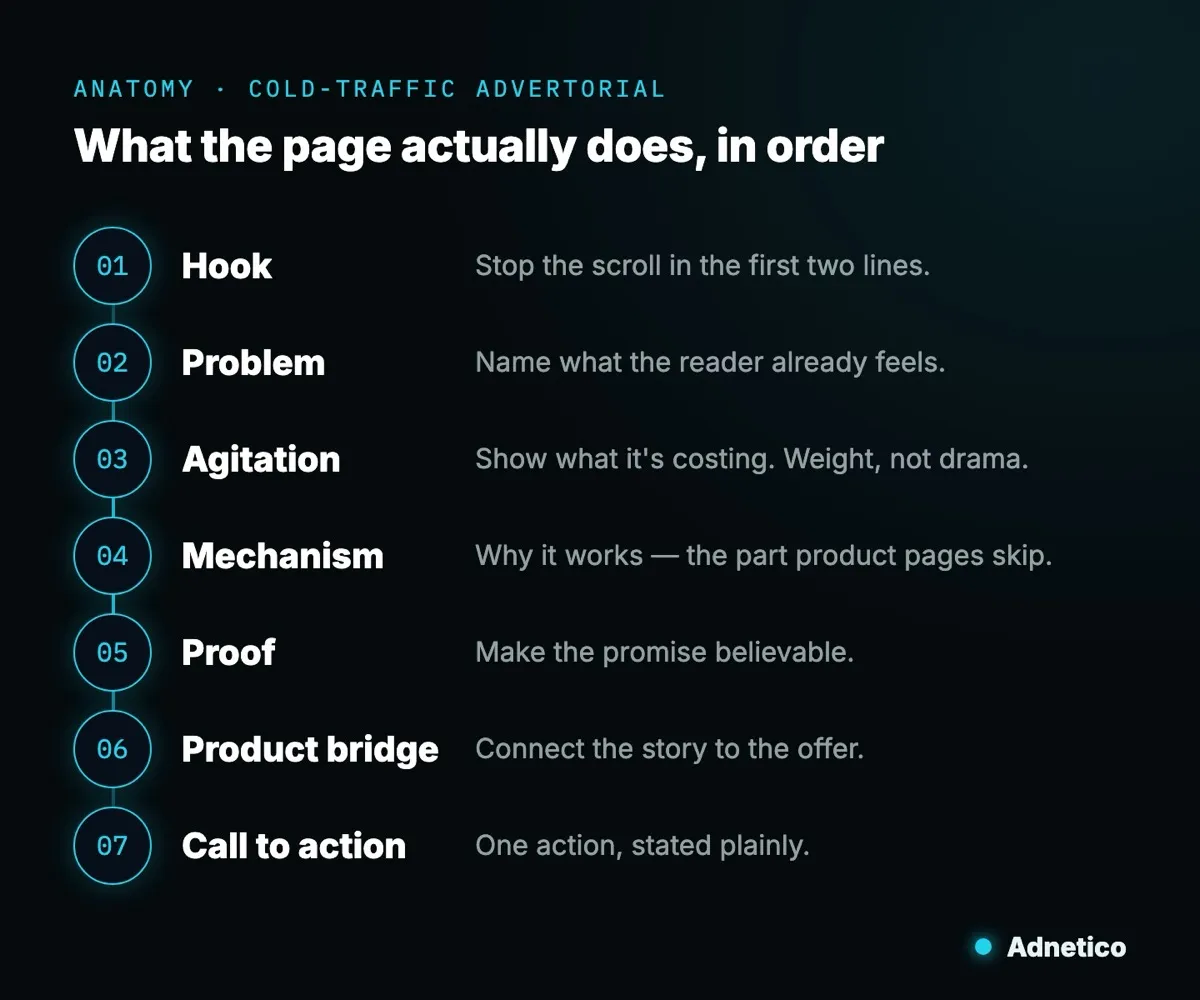
Strip away the style and every advertorial that works does the same seven jobs, in order:
- Hook. Stop the reader in the first two lines — a specific claim, a question they feel, or the start of a story. Not your product name.
- Problem. Name the problem in the reader’s own words, plainly, so they think “that’s me.”
- Agitation. Make the problem concrete: what it’s costing, what happens if nothing changes. Weight, not drama.
- Mechanism. Explain why your thing works — the insight, ingredient, or method that makes the promise believable. This is the part product pages skip and cold readers need most.
- Proof. Back it up — results, testimonials, credentials, data, a demonstration. Cold readers are skeptical by default; earn the belief.
- Product bridge. Connect the story to the actual offer. This is where the page stops being editorial and points at the thing to buy.
- Call to action. One action, stated plainly. Not three options — one.
A reader who moves through those seven steps lands on your product page already believing the three things it needs them to believe. That’s the whole point.
This isn’t a new trick
If the advertorial feels like a recent invention of native widgets, it isn’t. The channel is new. The format is old and well-tested.
In 1895, John Deere published The Furrow — a magazine of genuinely useful farming advice, with Deere’s equipment alongside it. Farmers read it because it helped them farm. It still runs today.
Eighty years later, a two-page letter for the Wall Street Journal — the “two young men” story, same college, different careers — ran almost unchanged from the mid-1970s to 2003 and is credited with roughly $2 billion in subscriptions. It opened with a person and a problem the reader recognized, not with the product. Eleven sentences of story did that.
The direct-response copywriters who systematized this — Hopkins, Ogilvy, Schwartz — proved one thing worth carrying into any native campaign: you don’t create desire, you channel a desire that already exists, by entering the conversation already running in the reader’s head. The tools changed. That hasn’t.
Where bad advertorials go wrong
The format has a bad reputation in some corners, and it earned it. Here’s how advertorials go wrong — and what separates persuasion from deception:
- Pretending to be real news. Fake logos, fake bylines, invented “as seen on.” Converts once, then burns the offer, the account, and the brand.
- Hiding the commercial intent. If a reader feels tricked the moment they realize it’s an ad, you’ve lost them — and likely broken platform and FTC rules.
- Teasing without teaching. Curiosity with no payoff. Readers feel cheated and leave.
- Pitching too early. Selling before you’ve earned attention or named the problem.
- Fake urgency. Timers that reset, “only 3 left” on unlimited stock. Skeptical readers spot it instantly.
- Claims without proof. A big promise with nothing behind it is the fastest way to lose a cold reader.
- A story that never connects to the product. Entertaining, then a non-sequitur pitch. The bridge has to be real.
The line is simple: persuasion takes something true and makes the reader feel its weight; deception invents the problem, fakes the proof, or hides that it’s an ad. Since the FTC’s 2015 guidance on native advertising, the second kind isn’t just bad business — it’s a compliance problem, and disclosure (“Sponsored,” “Ad”) is expected. An honest, clearly labeled advertorial often gives cold traffic a much better chance than sending it straight to a product page — because the persuasion was never the deception.
How advertorials fit a paid-traffic funnel
On native — Taboola, Outbrain, MGID — and on cold Meta and cold YouTube, the funnel usually runs:
Ad → advertorial → product page → checkout.
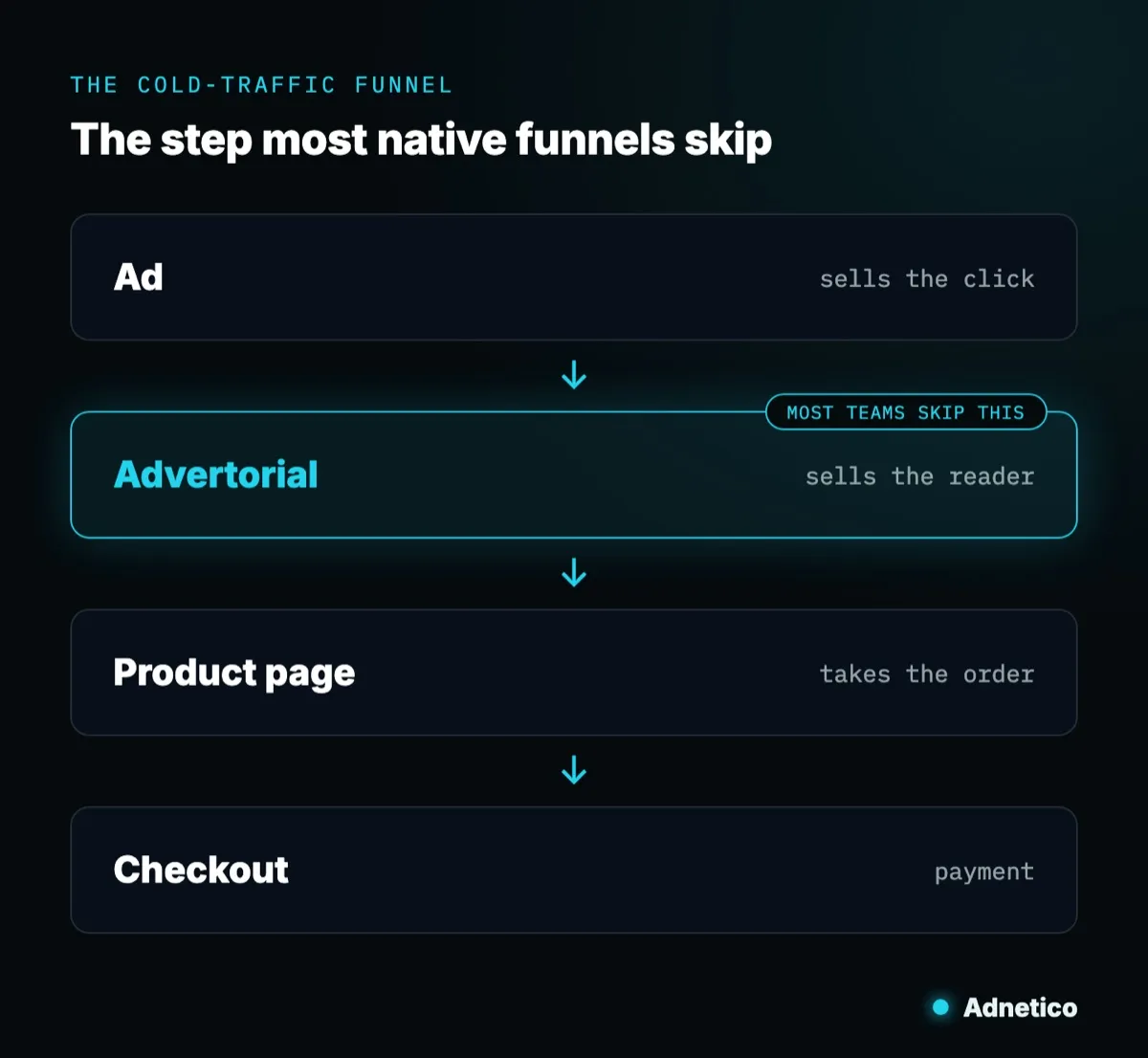
The advertorial is the second step, and it’s the one most teams leave out. Here’s why it matters to the math.
You don’t really control what a click costs — the auction sets your CPC. What you control is what the click does after it lands. And the point is blunt: if clicks cost the same but twice as many readers make it through to purchase, the whole campaign changes. You don’t need cheaper traffic — you need more of the traffic you already paid for to arrive convinced. On cold traffic, the advertorial is the highest-leverage place to make that happen, because it fixes the one thing a product page can’t: belief.
Skip it, and you’re paying native CPCs to send unconvinced strangers to a page built for the convinced. The CTR looks fine, the CPA doesn’t, and the campaign gets killed for “bad traffic” that was never the problem.
How we build advertorials at Adnetico
We build advertorials for cold-traffic campaigns — not generic blog posts dressed up as ads. Each one is designed around four things: the angle, the reader’s awareness level, the offer, and the platform it runs on. A page for cold Outbrain traffic on a supplement is not the same page as cold Meta traffic on a SaaS trial, and treating them the same is how money leaks.
We also don’t hand you one page and hope. We usually build three distinct variants, each on a different proven framework, so the campaign has real angles to test against each other — not a single guess you’re stuck with.
Where to go from here
If your native campaign is getting the click but losing the reader after it, that’s the gap we fix.
We build three advertorial variants around different angles — so you can test the story, not just the headline — each one shaped around your offer, your reader, and the platform it runs on. Order an advertorial package when you’re ready.
Not sure where the funnel is actually leaking yet? Take the free audit and we’ll point you at the real problem first — the page, the offer, or the angle.