What is direct-response copywriting? The craft behind every ad that actually sells
Most advertising is written to be admired. Direct response is written to be answered — with a click, an order, a booked call — and measured to the dollar. Here's the craft, the people who built it, and why your paid traffic runs on it whether you know it or not.

There are two kinds of advertising, and only one of them can be graded.
The first kind is written to be admired — brand campaigns, clever taglines, the ads that win awards and get shared in marketing Slack channels. What they sold is anyone’s guess: the results are diffuse, deferred, and rarely traceable to any single ad.
The second kind is written to be answered. A click, an order, an opt-in, a booked call — one specific action, from one specific reader, measurable to the dollar. That’s direct-response copywriting, and if you buy paid traffic, it’s not one option among many. It’s the craft your entire funnel runs on, whether anyone on your team has studied it or not.
This is the article I wish someone had handed me twenty years ago: what direct response is, the people who built it, and the handful of principles that haven’t moved in a century.
What direct-response copywriting actually is
Direct-response copywriting is writing whose only job is to make a reader act now — and whose success is measured by how many did.
That single sentence separates it from everything else that gets called copywriting:
- Brand copy builds recognition over months. Its results are diffuse and mostly unmeasurable at the level of a single ad.
- Content writing informs. The reader leaves smarter, with no particular next step.
- Direct response sells — on this page, in this session. If the response rate drops, the copy failed; if it rises, the copy worked. No award, no debate, just the number.
Every piece of a paid-traffic funnel is direct response by definition: the ad that sells the click, the advertorial that warms the reader, the quiz that segments them, the VSL that closes them. Different formats, one craft.
Where it came from: a century of measured selling
Direct response wasn’t invented for the internet. It grew out of mail-order — selling to strangers by post, where every ad carried a coupon or an address and every sale could be traced back to the exact piece of copy that produced it. The people who mastered that unforgiving arithmetic wrote the playbook that paid traffic still runs on. The names below aren’t nostalgia; each one contributed something you can use this week.
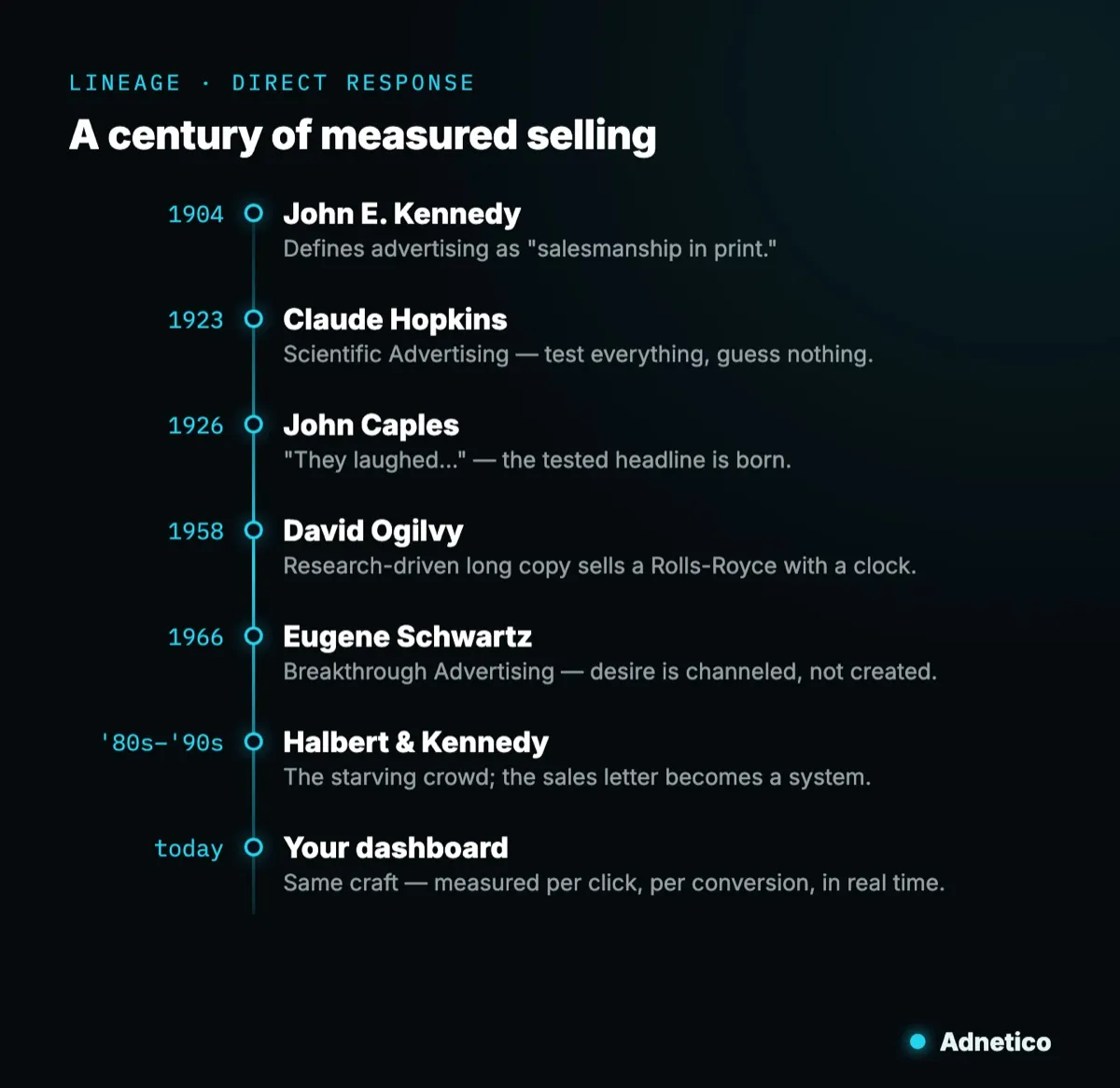
Claude Hopkins — the measurement. His Scientific Advertising (1923) made one radical claim: advertising is not an art to be admired but a discipline to be tested. Coupons, split tests, “reason-why” copy — Hopkins treated every ad as an experiment with a readable result. Exchange “coupon” for “tracking pixel” and the book describes modern performance marketing almost line for line. David Ogilvy said nobody should be allowed to touch advertising until they’d read it seven times.
John Caples — the headline. A former navy engineer who wrote the most-copied ad of all time — “They laughed when I sat down at the piano. But when I started to play!” (1926) — and then spent decades testing headlines scientifically at BBDO. His finding: one headline can outpull another by 19 to 1 with everything else identical. Ogilvy later put a number on the same lesson — on average, five times as many people read the headline as read the body copy — and between the two of them, that’s why direct-response writers spend half their time on it.
David Ogilvy — the research. The most famous adman of the century built his agency on direct-response discipline: long copy, specific facts, headlines that promise a benefit. His Rolls-Royce ad — “At 60 miles an hour the loudest noise in this new Rolls-Royce comes from the electric clock” — sold luxury with a single verifiable detail. His rule, “the more you tell, the more you sell,” is still tested and still true on cold traffic.
Eugene Schwartz — the strategy. Breakthrough Advertising (1966) is the hardest and most valuable book on this list. Two ideas earn its reputation. First: copy cannot create desire — only channel desire that already exists onto your product. Second: the stages of awareness — unaware, problem-aware, solution-aware, product-aware, most aware — because a reader at one rung needs a completely different argument than a reader at the next. Every prelander decision I make starts, consciously or not, with Schwartz’s ladder.
Gary Halbert — the reader. The most-quoted line in the trade is his: asked what advantage he’d want if he had to sell hamburgers against everyone else, his students said better beef, secret sauce, location. Halbert said he’d take “a starving crowd.” Offer and audience beat cleverness, always. His Boron Letters — copywriting lessons written to his son from prison — remain the best short course on writing like one human being talking to another.
Dan Kennedy — the system. Kennedy took what the mail-order masters did by instinct and turned it into repeatable structure — The Ultimate Sales Letter, Problem-Agitation-Solution, deadlines and guarantees engineered into every offer. If Schwartz is the theory, Kennedy is the manual. A generation of internet marketers — including the VSL and webinar builders — learned the trade from him.
Behind these six stand others worth knowing — Robert Collier (“enter the conversation already happening in the prospect’s mind”), Joe Sugarman (every sentence exists to get the next one read), Victor Schwab, John E. Kennedy, who defined advertising itself as “salesmanship in print” back in 1904. The bench is deep. The lesson is identical.
The principles that haven’t moved in 100 years
Strip the six masters down to what survives contact with a modern ad account, and you get a short list:
- The headline is most of the ad. Most readers never go further. Put the biggest true benefit there, not your brand name and not a pun.
- Specificity beats cleverness. “$35M managed since 2005” out-persuades “extensive experience.” Real numbers, real names, real timeframes — vague claims trigger skepticism, specific ones trigger belief.
- Write to one person. Not an audience, not a demographic — one reader, in “you,” about their problem. The word “you” should outnumber your product’s name.
- Benefits, not features. Nobody buys a 2,000-word advertorial; they buy what it does to their conversion rate. Translate every feature through “so what?”
- Desire is channeled, not created. If you’re trying to convince people to want something they don’t, the copy isn’t the problem — the offer is.
- One reader, one argument, one action. Every extra call to action divides the response. Pick the action and strip the rest.
- Honesty converts. The damaging admission — naming your own flaw before the reader does — has been building trust since Volkswagen captioned a photo of a Beetle “Lemon.” (the car had a blemish, so it didn’t ship) and Avis ran “We’re No. 2. We try harder.” It still works because it’s still rare.
None of this is style advice. Each one exists because somebody measured the alternative and it lost.
Why this matters if you buy traffic
Here’s the practical point hiding under the history: native advertising is direct-response advertising. So is cold Meta, cold YouTube, cold search. You pay per click, you measure per conversion, and everything between the impression and the sale is copy doing — or failing to do — a measurable job.
In my own campaigns, the copywriting is where the leverage lives. The auction sets what a click costs; the words decide what a click becomes. A headline change on a native ad moves CTR. A stronger mechanism section on an advertorial moves conversion rate. A reworded answer button on a quiz moves completion. None of those are bid changes — they’re Caples, Schwartz, and Halbert, applied to a dashboard the old masters would have envied.
One example for calibration. For NeuroNation, the brain-training app we ran advertorials for, we tested headline after headline until we found one that simply refused to lose: CPA came in 2–3× better than anything we put against it, and the difference was almost entirely the headline. The next-biggest gains came from swapping the hero image. Body-copy rewrites moved the numbers only after those two. Ninety years on, Caples’ hierarchy holds: the headline is most of the ad.
That’s also why “we’ll just write something” is the most expensive sentence in paid traffic. The craft has a hundred years of tested answers. Ignoring them doesn’t make the test cheaper — it just means you’re re-running it with your budget.
Where to start: a reading path
If you want the craft first-hand rather than filtered through blog posts, this is the order I’d read them in:
- Scientific Advertising — Hopkins. Short, free everywhere, the foundation.
- Tested Advertising Methods — Caples. Headlines and the testing mindset.
- The Boron Letters — Halbert. Voice, empathy, and the starving crowd.
- The Ultimate Sales Letter — Kennedy. Structure you can use the same day.
- Ogilvy on Advertising — the craft with its suit on.
- Breakthrough Advertising — Schwartz. Last, because it’s dense — and first among equals once you’re ready.
Six books, maybe forty dollars total for the ones that aren’t free. Cheaper than one day of a losing campaign.
Direct-response copywriting FAQ
Is direct-response copywriting dead in the age of AI?
No — the opposite. AI made producing copy cheap, which made knowing what good copy is more valuable, not less. The principles above are the grading rubric: an AI draft with a vague headline, no mechanism, and three CTAs fails the same way a human draft does. Tools changed; the reader didn’t.
What’s the difference between direct-response copywriting and content writing?
The intended next step. Content informs and builds trust over time with no specific action attached; direct response exists to produce one measurable action now. A blog post that ends by teaching you something is content. A page that ends with one button — and is judged by how many people press it — is direct response. (This blog is content; the advertorials we build are direct response.)
Can I learn direct-response copywriting without being a “writer”?
Yes — it’s closer to engineering than to literature. The skills are research, structure, and testing: knowing the reader’s awareness stage, choosing the right argument order, measuring the result, and iterating. Plenty of the best direct-response writers are ex-engineers, ex-salespeople, and media buyers who learned to write, not writers who learned to sell.
What should direct-response copy never do?
Lie. Fake testimonials, invented scarcity, mechanisms that don’t exist — they convert once and then cost you the ad account, the refund rate, and the brand. The masters were aggressive, not deceptive: every technique in this article works with true claims. If the copy only works when it lies, the offer is the problem.
Where to go from here
If you’re spending on paid traffic and suspect the words — the ad, the page, the argument — are where your funnel leaks, you’re probably right. It’s the highest-leverage fix in the stack and the least-tested one.
Take the free audit and I’ll tell you where the copy is costing you — the angle, the page, or the offer. And if what you need is direct-response copy built for cold traffic, that’s exactly what we make.