Quiz funnels: why they out-convert landing pages on cold traffic — and how to build one
A landing page asks a cold visitor for a decision. A quiz asks them a question. On paid traffic, that difference — one small yes instead of one big one — is often the whole ballgame.

Here’s an uncomfortable number to check in your analytics: how long does a cold visitor actually spend on your landing page?
For most paid campaigns it’s a few seconds. The visitor clicked your ad out of curiosity, landed on a wall of arguments — headline, benefits, testimonials, pricing — glanced at it, and left. You paid for a reader and got a bouncer.
The standard fix is to rewrite the page. Better headline, tighter copy, stronger proof. Sometimes that works. But there’s a structural option most teams never test: stop presenting, start asking.
That’s a quiz funnel. And on cold traffic — especially native traffic, the sponsored “recommended for you” ads under news articles on networks like Taboola, Outbrain, and MGID — it’s often the highest-converting page format I know. It’s also not magic, and it’s easy to build badly. Let’s take it apart.
The problem: a landing page asks for too much, too early
A landing page is a monologue. It makes its case and then asks for the conversion — the signup, the order, the booked call. For a visitor who already wants the thing, that’s fine.
But a cold visitor — someone who clicked a native ad, or an ad in their Meta feed — hasn’t agreed to anything yet. They’re not ready to decide. They’re barely ready to read. A landing page hands them one big decision: act, or leave. Most leave.
A quiz flips the interaction. Instead of one big yes, it asks for a series of tiny ones:
What are you trying to do? How much are you spending? What have you tried?
Each question takes two seconds to answer. Nobody needs convincing to tap a button that describes them. And with every answer, something changes on the visitor’s side: they’ve stopped being an audience and started being a participant.
What a quiz funnel actually is
A quiz funnel is a short, step-by-step flow — usually 4 to 9 screens, one question per screen — that a visitor works through before they see the offer. At the end, their answers route them to a result: a recommendation, a diagnosis, a plan, an offer matched to what they said.
In paid-traffic terms, it’s an interactive prelander — the page a paid click lands on before it reaches the actual offer. Its job is to warm a cold visitor up so the offer doesn’t have to do all the work. Where a story-format prelander persuades with narrative, a quiz warms the visitor with their own answers.
You’re on one right now, in a sense — this site routes agency prospects through a short diagnostic quiz instead of a contact form. Same logic.
What a quiz funnel is not
It’s worth clearing up the name, because “quiz” drags in the wrong associations. A funnel quiz isn’t a BuzzFeed personality test — “which Marvel character are you” entertains, while a funnel quiz qualifies and routes. It isn’t a long form chopped into pieces, either: ten CRM fields across ten screens is still a ten-field form, and visitors can tell a conversation about them from data entry for you. And it isn’t a trick. The result has to be a real answer to what the visitor told you — if every path leads to the identical pitch, people feel it, and you’ve burned the trust the whole format is built on.
You probably need one if…
- Your offer has more than one kind of buyer — different situations, budgets, or problems that deserve different pitches.
- Your product needs a short diagnosis before the right recommendation is even clear (supplements, skincare, fitness, finance, services).
- You’re buying cold traffic and your landing page bounce rate says the monologue isn’t landing.
- Your lead quality is bad — the sales calls are full of people who should never have booked. A quiz filters before the calendar does.
- You sell something where “it depends” is the honest answer to the main buying question — a quiz turns “it depends” into “it depends on these four things, let’s find out.”
If none of that applies — one product, one buyer, warm traffic — a quiz just adds steps. Keep the landing page.
The anatomy of a quiz funnel that converts
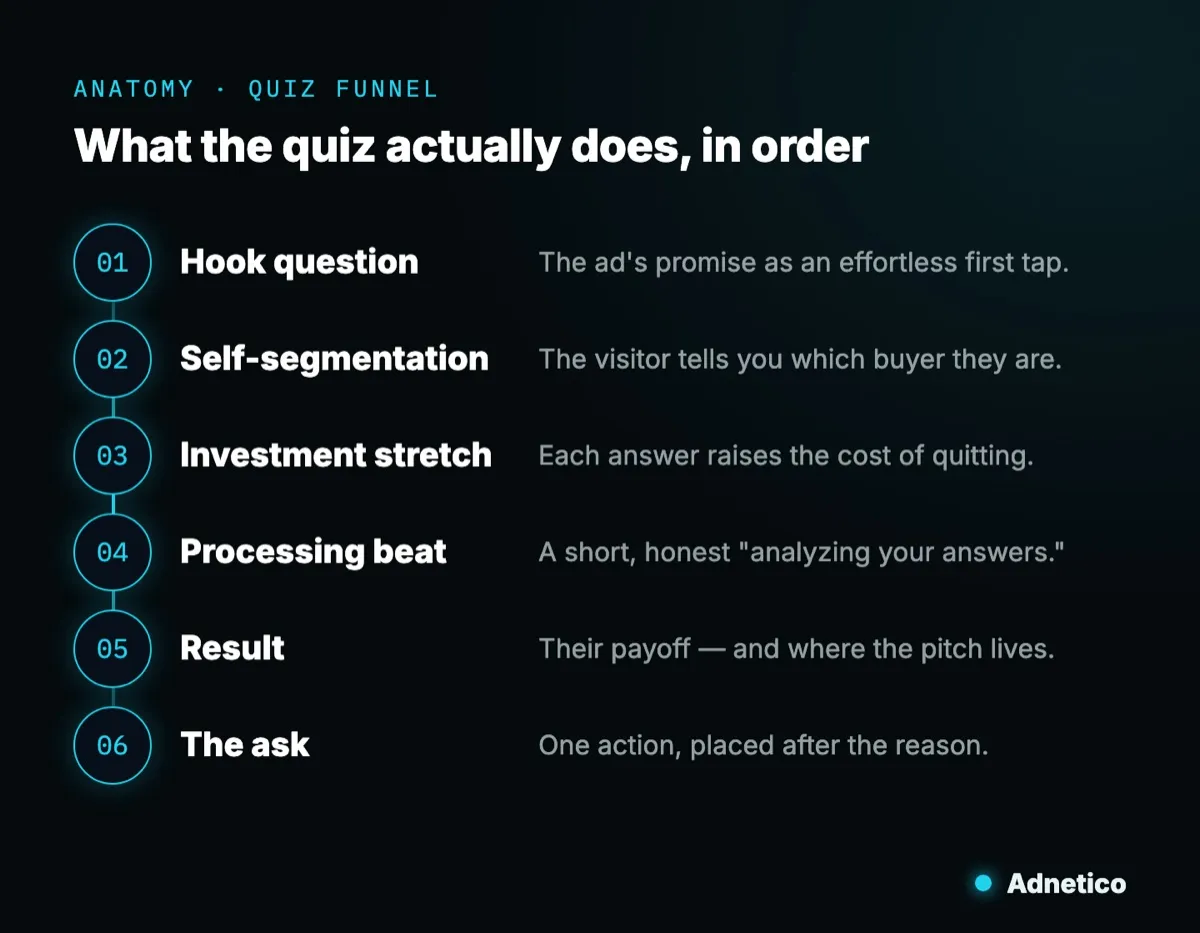
The ones that work share the same skeleton:
- The hook question. The first screen is the ad’s promise turned into a question. It must be effortless — a tap, not an essay. Curiosity does the pulling.
- Self-segmentation. Two or three questions where the visitor tells you which buyer they are: their situation, their spend, their goal. These answers pick the pitch.
- The investment stretch. A few questions that deepen engagement — what they’ve tried, what failed, what they’d change. Each answer raises the cost of quitting: they’ve put something in now, and they want the payoff.
- The processing beat. A brief “analyzing your answers” moment before the result. It signals that the answers mattered — the result is theirs, not a template. Keep it honest and keep it short.
- The result. The payoff screen: what their answers mean, and what to do about it. This is where the quiz becomes a pitch — the recommendation is the offer, framed by everything they just told you.
- The ask. Email capture, order, booked call — one action. Placed where it costs the least: after the visitor is invested and the result has given them a reason.
Get the order wrong — ask for the email on screen one, pitch before the result, stretch to fifteen questions — and the funnel leaks exactly like the landing page did.
Why it works: the psychology is old, the format is new
None of this is a growth hack. The mechanics are the same ones direct-response has leaned on for a century.
Small commitments compound. Robert Cialdini documented it as commitment and consistency: people who take a small step toward something are far more likely to take the next one. Every tapped answer is a small step. By the end of the quiz, saying yes to the offer is consistent with ten tiny yeses already given — while on a landing page, the first yes you ask for is the biggest one.
People finish what they start. An open loop wants closing. Once someone is four questions into a seven-question quiz with a progress bar, abandoning it feels like losing something. The result screen is the closure — and they’ll travel to reach it.
Answers are attention. A visitor reading your page can drift. A visitor answering questions can’t — the format demands micro-decisions, and micro-decisions hold focus. You’re not fighting for attention; the interaction generates it.
The pitch arrives pre-personalized. By the result screen, you know who you’re talking to — the segment, the pain, the budget — because they told you. The offer can speak to their situation in their own words. That’s Robert Collier’s old rule about entering the conversation already happening in the prospect’s mind, except now the prospect wrote the opening lines for you.
Where bad quiz funnels go wrong
The format has sharp edges. The common failures:
- Questions that serve you, not them. A question that exists only to fill your CRM turns the conversation into an interrogation.
- Fake analysis. A loader “calculating” a result that’s identical for everyone. When the theater is discovered — and it is — trust dies retroactively.
- The bait-and-switch result. Ten questions about their situation, then a generic pitch that ignores every answer. The one unforgivable sin.
- Too long. If a question doesn’t change the routing or the pitch, cut it — it’s trading completion rate for data you won’t use.
- Asking for the email too early. Gate the result if you like, but the visitor has to want the result first. Screen-one email gates are just forms with decoration.
- Compliance blind spots. Quiz promises (“get your personalized plan”) carry the same ad-platform scrutiny as any other claim, and sensitive-topic questions (health, money) need honest handling. Persuasion is fine; deception is expensive.
How quiz funnels fit a paid-traffic funnel
On cold traffic the flow looks like this:
Ad → quiz → result (the pitch) → offer / lead capture.
The quiz competes for the same slot as the advertorial — a story-format selling page — and choosing between them is mostly a question of what the offer needs. A story does some jobs better: complex mechanisms, skeptical markets, high prices that need a full argument. A quiz does others better: segmented audiences, diagnostic products, lead generation, offers where the visitor’s situation genuinely changes the recommendation. Plenty of campaigns run both and let the numbers decide.
The economics don’t change either way: the ad auction sets your CPC (cost per click), and the page decides what each click becomes. A quiz that gets a cold visitor to participate — instead of judging your headline from the doorway — is one of the most reliable ways I know to move that second number.
How we build them at Adnetico
Quiz funnels aren’t a side interest here — they’re most of what I’ve shipped on native for the last decade. Gaming, e-commerce, supplements, lead gen: the surface changes, the skeleton doesn’t.
What I’ve learned building them: the questions are copywriting, not UX. Which question comes first, which words the answer buttons use, where the investment stretch ends and the result begins — that’s where the conversion rate lives, and it’s tested, not guessed.
Two numbers from my own campaigns to make that concrete. On gaming offers, our quiz prelanders typically reach an LP CTR — the share of visitors who click through from the quiz to the offer — of around 25% in the US, and 35–40% in some other geos. One cold visitor in four, walking through to the offer warmed up.
And the counterintuitive one: quiz length is a balance between completion and lead quality, and shorter doesn’t automatically win. On the same gaming vertical, a 7-question quiz beat a 3-question version by roughly 30% on completion rate — and produced better-quality leads on top. The extra questions built more investment, not more drop-off. It’s always a matter of testing, never a rule.
Small structural changes move real money in this format — which is why the skeleton above is worth taking seriously.
Quiz funnel FAQ
How many questions should a quiz funnel have?
Four to nine, one per screen. Below four, there’s not enough interaction to build investment or segment the visitor; past nine, each extra question trades completion for data you won’t use. But don’t assume shorter wins inside that band — in my gaming campaigns, a 7-question quiz beat a 3-question version by ~30% on completion, with better leads. The test for every question: does the answer change the routing or the pitch? If not, cut it.
What’s a good quiz completion rate?
There’s no universal benchmark — completion swings hard with vertical, geo, and traffic source. For calibration from my own campaigns: 10–15% can be a good number in auto-insurance lead gen, gaming should do far better, and a digital weight-loss product I promoted averaged close to 40%. The same quiz also usually completes higher on Meta or Google Search traffic than on native — which is why you track soft conversions downstream to judge lead quality, not completion alone. Whatever your level, watch the shape: most drop-off should happen on the first screen — track completion per step, fix the biggest cliff, repeat.
Quiz funnel vs. landing page — which converts better?
Neither, universally. A quiz usually wins on cold traffic when the audience is segmented, the product needs a diagnosis, or lead quality matters. A landing page wins with a single clear buyer, warm traffic, or an offer that needs no explanation. When in doubt, run both — the answer is rarely close.
What tools do you build quiz funnels with?
For low-volume lead gen, off-the-shelf builders (Typeform-style tools or WordPress quiz plugins) are fine. For paid traffic I build custom static pages: they load faster than any embedded widget, and you keep full control over tracking, split tests, and platform compliance — the three things that decide whether a campaign scales.
Where to go from here
If you’re buying cold traffic and your landing page is doing all the talking, a quiz might be the test that changes the campaign’s math.
The honest first step is diagnosis, not a rebuild — take the free audit (yes, it’s a quiz) and I’ll tell you where your funnel is leaking and whether a quiz, an advertorial, or a different angle is the right fix. If the answer turns out to be the warming page, that’s what we build.